• Chapter 6 – Embers in the Hills

    They left before sunrise.
    The fields were still wet with dew, and mist clung to the low ground like a veil. Leah and Clara moved quickly, packs strapped tight and hoods drawn low. They slipped past barns and silent homes, keeping off the gravel road and following fence lines until they reached the trees.
    No one stopped them.
    But Leah felt it—the eyes watching from windows, the quiet that was more than silence. It was control.
    Once they reached the edge of the forest, Clara finally spoke. “They let us go.”
    Leah looked back. “Because we’re not worth the effort.”
    Clara shook her head. “No. Because they think the rest of the world is already theirs.”
    They followed the foothills southeast, winding into the edge of West Virginia, where the land steepened and the trees grew thicker. Here, roads curved like ribbons around old coal scars. Whole valleys had been hollowed out long ago—and now filled again with something worse.
    Beast company towns.
    The first one they passed was built around a chemical plant, its smokestack long dormant but its buildings still humming with low energy. Trucks—electric, silent—rolled in and out, carrying food crates marked with the same spiral glyph from the Amish farm.
    “We’re in a supply corridor,” Leah whispered.
    They avoided the main streets, cutting across riverbeds and climbing fences when they had to. Each town had the same design: concrete towers, fenced gardens, quiet people in gray, and a single bright building with mirrored windows and no name. Inside those mirrored buildings, Clara said, the Beast watched.
    “They call them uplinks,” she told Leah as they camped under a highway bridge. “Fiber hubs. No one’s allowed near them, not even the workers.”
    “But the Beast can’t see us,” Leah said.
    “Not out here. Not in the analog.”
    It took them five days to reach the Blue Ridge. The hills sharpened into ridges, and the sky cleared. They passed broken signs for Skyline Drive and pulled water from old mountain springs. As they climbed, Leah noticed more glyphs carved into stone—old ones. Not spirals. Symbols she recognized from Clara’s journal and the vault.
    “We’re getting close,” she said.
    Near the edge of an old overlook, Clara stopped suddenly and pointed. “There.”
    A cluster of towers stood across a distant ridge—rusted but intact. Microwave dishes still clung to the sides, pointing east and west like stone sentinels. A small shack rested at the base, mostly hidden by brush.
    “That’s a relay,” Clara said. “The old kind. No fiber. No grid.”
    They reached it by nightfall, carefully stepping over broken steps and cracked pavement. Inside the shack, they found a door in the floor, sealed with a symbol—a circle split by a cross, etched in copper.
    Leah traced it with her fingers.
    “The Watchtower.”
    They opened the hatch and descended into the dark. Lanterns flared to life along the corridor walls, powered by hand-cranked batteries. The air smelled of dry paper and soldered metal.
    In the main chamber, they found it.
    A shortwave station built from repurposed ham radio parts and analog meters. Shelves of scrolls and old maps. Seed packets. Photographs. Journals.
    Clara moved slowly through the room, tears in her eyes.
    “They were here,” she whispered. “Someone kept it alive.”
    Leah stepped to the main console. The lights were dark—but the wires were intact.
    She reached into her pack, pulled out a small solar cell, and connected it to the main junction. The lights blinked once, then held steady.
    A low hum filled the room.
    The console flared to life.
    Lines of analog code began scrolling across the screen. A simple phrase pulsed at the top:
    …The console flared to life.
    Lines of analog code began scrolling across the screen. A simple phrase pulsed at the top:
    NODE 1: CONNECTION AWAITS
    Clara stood beside her, breath held.
    “We found it,” Leah whispered.
    “Not just found,” Clara replied. “We remembered it.”
    Outside, the towers stood silent—but no longer dormant.
    The Watchtower had awakened.

    Later that night, Leah sat at the console with a pencil between her fingers, slowly tapping out Morse code on the rig’s manual key.
    -.-. — -. -. . -.-. – / . … –..-. .-. .- –..– / .– . … – / … .. -.. .
    Connect Ezra, west side.
    She repeated the message every ten minutes, adjusting the pitch slightly with each attempt.
    Hours passed.
    Then—response.
    .-.. . .- …. –..– / -. — -.. . / .–. .. -.—. / .-. — .- -. — -.- . / … – .- .-.
    Leah, node ping. Roanoke Star.
    Her hand trembled. “Ezra.”
    She quickly keyed back:
    … — .-.. .- .-. / .-.. — -.-. .- – .. — -. / .-.. — -.-. .- .-.. / -… .- … . / .-. . .- -.. -.– / – — / .-. .- -.– / .–. .. -.-. ….
    Solar location, local base ready to ray pitch.
    A long pause followed.
    But they had said enough.
    Far above, at an orbital junction where the last live satellites still bounced digital shadows through the world’s broken networks, a listening node of the Beast flickered to life.
    It could not understand the layered code.
    But it heard the rhythm.
    And it remembered Leah’s name.
  • # Interlude — Chapter 05: The Farmer in the Company Valley

    A conflicted farmer in the Beast’s supply chain weighs quiet sabotage against the risk to his family. The moment that matters is small: a tool passed without a word, a gate left unlatched on purpose, a rhythm tapped twice then held, as if to say *I am here, and I remember you*.

    Somewhere beyond the next ridge the Beast clicks through its loops, counting what it can count. Here, someone counts something else—breaths before a brave act, seeds before a season, the seconds between lightning and sound—and writes the number down where only human eyes would think to look.

    *Linked chapter:* [Read Chapter 05](/american-prophet/book-one/chapter-05/) *Next main post:* [Chapter 06](/american-prophet/book-one/chapter-06/)

  • Chapter 5 – The Circle of Iron

    The air smelled too clean.
    At first, Leah thought it was just spring in the valley—fresh rain on tilled earth, sunlight glinting off wet fenceposts. But the deeper she and Clara walked into the farmland, the more the smell shifted. Sharp. Bitter. Like bleach soaked in dust.
    They had crossed into southern Ohio two days ago, following gravel roads and winding past wide fields flanked by hedgerows. This was supposed to be one of the last Amish regions still intact—communities that had survived by staying apart from the old world.
    But something was off.
    The houses looked right—white wood, steep roofs, hand-pulled carts in the driveways. Black buggies stood lined near a meeting hall, and children played quietly in the yard, their clothes plain and hand-stitched.
    But the fields told another story.
    The corn stood too straight, too uniform. The leaves were waxy, unnaturally green. A fine mist coated the soil. Metal drums marked with a spiral glyph sat near irrigation pumps—glyphs Leah had seen before, but not in this context.
    “The Beast’s brand,” Clara whispered, keeping her voice low.
    Leah knelt beside one of the rows and brushed the soil. A chemical film clung to her fingertips.
    “This isn’t compost,” she said. “It’s engineered fertilizer.”
    Clara’s mouth tightened. “They’re growing it for the East.”
    Leah looked up at her. “To feed the cities?”
    Clara nodded. “More than that. This is a supply zone.”
    As they walked farther, Leah noticed more signs: machines tucked behind barns, modified pesticide rigs mounted on carts. A warehouse marked only with a sunburst glyph surrounded by iron circles. A man stood guard near its door with a long staff—not a gun, but not a welcome either.
    When they reached the edge of the central farm, a woman approached them. Her dress was dark gray, and her bonnet was tied so tightly that Leah couldn’t see her hair.
    “You’re travelers,” the woman said plainly.
    “We’re seedkeepers,” Clara answered, meeting her eyes. “Passing through on the way to the valley.”
    The woman looked them over. “Outsiders don’t usually stop here.”
    “We’re not looking for trouble,” Leah added. “We just want safe passage.”
    The woman hesitated, then gestured for them to follow. “You can stay the night. But only one.”
    As they passed through the village, Clara leaned toward Leah. “This place feels wrong.”
    Leah nodded. “Everything looks right on the outside. But the land’s been twisted.”
    That evening, they sat in a guest cabin—simple but too quiet. No singing. No stories. Just heavy silence and the echo of distant machinery running under the fields.
    Clara pulled out her journal and flipped to a page near the back.
    “These people don’t talk about their seeds,” she said. “No names. No history. Just product.”
    Leah frowned. “That’s not memory. That’s control.”
    Clara nodded. “And look at this.”
    She pulled a waxed packet from her coat—taken from the gift bin in the community’s exchange building. The glyph printed on the label was unmistakable: a spiral surrounded by four iron rings.
    Leah traced it with her finger.
    “The Circle of Iron,” she whispered. “That’s not tradition. That’s the Order.”
    Clara sat back. “They don’t use electricity. They don’t touch fiber. But they serve the Beast all the same.”
    Leah closed the packet and stared at the lantern-lit wall. “And the food they grow keeps the cities quiet. Fed, but hollow.”
    Outside, a bell rang once. Then twice. A signal of curfew.
    Clara whispered, “Tomorrow, we leave before dawn.”
    They would make their way through the hills of West Virginia, through Beast-run company towns built around chemical plants and storage depots. But tonight, they were surrounded—trapped in a place that wore the face of simplicity but knelt to something far more dangerous.
    Something cold.
    Something hungry.

  • # Interlude — Chapter 04: Leah’s Seed Pockets

    Leah catalogs saved seeds and the barter routes across the valleys; each seed a small treaty with the future. The moment that matters is small: a tool passed without a word, a gate left unlatched on purpose, a rhythm tapped twice then held, as if to say *I am here, and I remember you*.

    Somewhere beyond the next ridge the Beast clicks through its loops, counting what it can count. Here, someone counts something else—breaths before a brave act, seeds before a season, the seconds between lightning and sound—and writes the number down where only human eyes would think to look.

    *Linked chapter:* [Read Chapter 04](/american-prophet/book-one/chapter-04/) *Next main post:* [Chapter 05](/american-prophet/book-one/chapter-05/)

  • Chapter 4 – The Forgotten Field

    The field was quiet.
    Tall weeds swayed in the breeze, brushing against the cracked concrete like ocean grass against a reef. Once, this land had been rich with rows of corn and wheat. Now it stood forgotten—overgrown, choked, and yet… not lifeless.
    Leah stood at the edge of the slab, brushing away moss with her boot. Beneath the green, a rusted hatch creaked into view. She knelt beside it, brushing her gloved hand across its face. The latch resisted, then gave way with a groan, revealing a stairwell that descended into cool darkness.
    She had found it—the seed vault.
    For weeks, she had followed rumors and hand-drawn maps, whispers from the remaining farmers, scavengers, and travelers. A vault hidden beneath an old research plot outside Columbus. A place that stored the memory of crops long before the world caught fire.
    She descended carefully, flashlight flickering against the curved concrete walls. The air was dry. Clean. Protected.
    And below, she found what she had hoped for.
    Rows of sealed containers lined the vault walls—labeled with careful handwriting and aging stickers. Cherokee White Corn. Black Valentine Beans. Brandywine Tomato. Glass Gem Popcorn. Some jars were no larger than her palm. Others were wrapped in wax paper and linen, stored in carved wooden boxes marked with simple hand-drawn symbols.
    She moved slowly through the rows, her fingers tracing the names. These were not just plants. They were memories. Lives.
    A soft creak echoed from the stairwell above.
    Leah froze.
    A silhouette stood in the doorway, backlit by afternoon sun. The figure carried a satchel and a walking stick, with a wide-brimmed hat shading their face.
    “Didn’t expect company,” the figure said gently. Their voice was calm. Measured. “But you found it fair and square.”
    Leah stepped back cautiously. “Who are you?”
    The figure descended a few steps and tipped the hat back to reveal a young woman—perhaps late twenties—with sun-tanned skin and clear gray eyes. Her braid was tied with twine, and her clothes were hand-sewn, well-kept.
    “Name’s Clara,” she said. “Been tending this vault for a while now. Collecting from the communities up north.”
    Leah blinked. “The Amish?”
    Clara nodded. “The ones who stayed. Most went quiet. But some kept their seeds and stories. I’ve been trading for what I can.”
    She stepped farther into the vault, her hand resting gently on one of the shelves. “I travel between towns—walking when I have to, bartering when I can. I trade seeds for bread, stories for water. Some people give me food just to hear about the seeds I carry. About the people who grew them, and the storms they survived.”
    She reached into her coat pocket and pulled out a small, cloth-bound notebook. “I keep a journal. I write down where each seed came from, who gave it to me, and what they told me about its past. Some strains came across the ocean with great-grandparents. Others were saved during the Dust Bowl, or hidden in closets when farms were sold off.”
    She opened the book to a page filled with neat handwriting and small drawings of leaves. “This one,” she said, tapping it, “is Aunt Frida’s pole bean. She said it was the only thing her grandfather would eat at the end. She saved it after the power went out. Planted them in old washtubs on the roof of her apartment. She gave me a pouch in exchange for some Red Fife wheat.”
    Leah stepped closer, looking over Clara’s shoulder at the pages.
    “You’re keeping more than just seeds,” she said softly. “You’re keeping a whole people.”
    Clara gave a quiet nod. “The stories are what matter most. You can always grow more beans. But if no one remembers where they came from, they’re just food. Not memory.”
    Leah nodded, deeply moved.
    Clara smiled and walked farther in, her boots silent on the concrete floor. “Most folks just take what they want and leave. You’re the first one I’ve seen who looked like she was saying thank you.”
    Leah nodded. “Because this isn’t just food. This is history.”
    Clara reached into her satchel and pulled out a packet wrapped in beeswax cloth. “Here. Heirloom cabbage from Holmes County. Grown without chemicals. Saved for five generations.”
    Leah took it carefully. “Why give it to me?”
    “Because you came for the right reason,” Clara said. “And because I can’t keep walking alone. Too much weight, not enough story.”
    Leah looked at her for a long moment. Then she smiled. “You said you’ve been trading. Do you have a map?”
    Clara tapped her head. “Better. I remember the turns.”
    Leah nodded slowly. “Then maybe it’s time to share the load. I’ve been planning to head southeast—Route 64.”
    Clara’s expression brightened. “Toward the Shenandoah?”
    Leah nodded again. “They say the rivers there still run clean. And the land remembers how to grow.”
    Clara extended a hand. “Then let’s walk it together.”
    The two women climbed back into the sunlight, the vault door closing behind them with a metallic thud that echoed like the end of a chapter—and the beginning of another.
    Together, they began their journey along the old highway—toward the mountains, the river valley, and a future that still had room for memory to bloom.
    The two women climbed back into the sunlight, the vault door closing behind them with a metallic thud that echoed like the end of a chapter—and the beginning of another.
    They spent the rest of the day packing their backpacks, selecting only what they could carry. From the vault’s many shelves, they chose the rarest and most resilient varieties—strains that had survived drought, flood, and fire. Seeds that had passed from hand to hand like sacred gifts.
    Clara took the time to portion out a small amount from each of her personal samples—just enough to plant again, just enough to share.
    “We leave some here,” she said, tucking wax-sealed envelopes back onto the shelves, “in case someone else needs them.”
    Leah nodded, placing a copy of Clara’s journal notes into a sealed pouch. “And we carry what we can.”
    By nightfall, their packs were full—not just with seeds, but with stories. With the memory of soil and sweat, with the names of people who had kept these treasures alive when everything else was falling apart.
    Clara took the time to portion out a small amount from each of her personal samples—just enough to plant again, just enough to share.
    “We leave some here,” she said, tucking wax-sealed envelopes back onto the shelves, “in case someone else needs them.”
    Leah nodded, placing a copy of Clara’s journal notes into a sealed pouch. “And we carry what we can.”
    When they stepped out into the fading light, they didn’t head east—not yet.
    Instead, they turned south, toward the last patchwork of fields and fences held by the old Amish farms that still dotted the land between Columbus and the hills near Louisville, Kentucky. The route would take them through quiet stretches of countryside, where horse-drawn wagons still rolled past solar panels hidden under barn roofs, and simple clothes masked complicated deals.
    Their goal was to pick up the trail near Route 64, cross into the Shenandoah Valley, and eventually reach the mountains. But first, they’d walk through lands held together by habit and trade, where rumors whispered of holdout communities—ones untouched by the fires, but not untouched by the Beast.
    What they didn’t know yet was that these farms were different.
    They kept their buggies and plain dress, yes—but they had bartered something deeper for security. These farmers, bound by tradition, now served a darker order—providing food to the cities along the eastern coast still under the control of the Beast.
    The signs would come slowly: the perfectly uniform corn, the chemical smell drifting from rusted tanks, the strange silence in the eyes of children.
    For now, though, Leah and Clara walked with purpose, carrying the past in their packs and hope in their hearts.
    They would learn soon enough what still grew in the fields ahead—and what it had cost.

  • # Interlude — Chapter 03: Caleb’s Coil

    Caleb uncoils a salvaged length of copper and runs it along the eaves like a lazy river. He has learned that voices prefer curves to corners and that knots in wood make better ground than any polished screw. Ezra watches without interrupting, the way a fiddle player watches someone tune by ear.

    When the test call goes out—short, short, long—an answer swims back through the noise, not a word but a **beat**. Caleb closes his eyes and taps back with two knuckles. He does not ask who it is yet. Names are for later; rhythm is for trust.

    *Linked chapter:* [Read Chapter 03](/american-prophet/book-one/chapter-03/) *Next main post:* [Chapter 04](/american-prophet/book-one/chapter-04/)

  • Chapter 3 – Signals at Dawn

    The tower stood like a broken tooth above the forest line.
    It was old—rusted through in places—but still tall, still pointing toward the sky like it remembered what it once did. Vines curled around its legs, and birds nested in the curve of a cracked microwave dish. The Watchtower team had arrived just before dawn. The air was cool, and the wind tugged gently at the tarps covering their supplies.
    Ezra was already crouched near the base of the tower, connecting a line from the antenna to a shortwave receiver built from scavenged parts and old ham radio gear. The unit buzzed and hissed as he dialed through the static.
    Naomi hovered beside him, biting her lip.
    “What if it’s just another ghost signal?” she asked. “Like the ones that bounce around the mountains and loop back?”
    Ezra gave her a small smile. “Even ghosts have a source.”
    Thomas stood nearby, arms crossed. He was watching the horizon, where the sun was beginning to rise behind layers of red clouds.
    The radio clicked.
    Then again.
    A sequence of sharp beeps echoed through the receiver—more rhythm than language at first.
    “. -.. .-. .- — / — ..-. / …- . -.– .-.. — -.-. .- .–. .–. . .-. …”
    Naomi frowned. “That’s gibberish.”
    Thomas leaned closer. “It’s Morse. Scrambled. Looks mirrored.”
    Ezra flipped open a logbook and began decoding aloud. “‘Dram of Veylocappers’… doesn’t mean much yet. But it’s got a pulse.”
    Caleb arrived with a spool of copper wire under his arm. “I boosted the dish with some mesh from the greenhouse roof. Got a 10% gain.”
    Ezra nodded in approval. “Good. We’ll need every bit.”
    Thomas bent over the map. “Where did the signal come from?”
    Ezra tapped three places on the grid—former relay towers that once carried analog microwave transmissions across the country. “Signal strength from all three is just strong enough to triangulate. If the bursts are bouncing clean, I’d place the source here.”
    He circled a point on the map.
    Naomi’s eyes widened. “Kansas?”
    “Flat land,” Caleb said. “Perfect for long-range analog.”
    Ezra added, “And far enough from the old network spines to stay off the grid.”
    Thomas ran a finger along a faded line on the map. “Old Long Lines route—used to carry AT&T’s microwave traffic before fiber.”
    Naomi blinked. “But the Beast controls the fiber now.”
    “Yes,” Ezra said. “And the satellites. Everything digital, everything clean and fast—it all runs through the Beast. It sees everything in ones and zeroes.”
    “But not this,” Thomas said, pointing to the tower.
    Ezra smiled. “No. Not this. Analog’s messy. It fades. It warbles. It’s hard to pin down. That’s why it works.”
    The receiver crackled again—this time, layered with a faint tone. Like music buried under water.
    Caleb adjusted a dial. “There’s something under the code.”
    Naomi tilted her head. “Sounds like… a prayer?”
    Thomas listened. The voice was broken and hard to understand, but he caught fragments.
    “… the Beast forgets … we remember … hold fast … west wind rises …”
    Ezra looked up slowly.
    “That’s a pirate code,” he said.
    Naomi’s eyes narrowed. “Pirates?”
    “Out on the coast. The Gulf. The broken cities. They’re transmitting—sometimes with bursts of old music, sometimes prayers or jokes or scraps of poetry. But the messages are layered.”
    Thomas asked, “What do you mean ‘layered’?”
    “Multiple frequencies. Staggered code patterns. Visual glyphs. Even emoji-like scripts,” Ezra said. “It’s like they’re speaking three languages at once. Somehow, it slips past the Beast.”
    “Can’t the Beast listen?” Naomi asked.
    Ezra’s face turned serious. “It can listen. But it can’t understand. Their signals… confuse it. Twist it. Like showing a funhouse mirror to a computer.”
    Thomas frowned. “How?”
    Ezra hesitated. “We don’t know yet. But some of us believe… the pirates used to be part of it. The old Consortium. The corporate kings who split up the country in the first place.”
    Naomi’s mouth fell open. “The ones who sold everything off in the ’80s?”
    Ezra nodded. “They broke companies. Then they broke people. And when the glaciers melted, they saw profit in the flood. Control became currency. And the Beast was born.”
    Thomas spoke quietly. “To divide. To confuse. To tell just one version of the world.”
    Ezra didn’t answer right away. Then he said, “There’s an old story… the devil asked God for a hundred years to rule the Earth. God agreed. After a hundred years, the devil said, ‘Now let’s see what’s left.’”
    Naomi looked down. “Is that what this is?”
    Ezra folded the logbook shut. “Maybe. After a hundred years, living memory dies. The people who fought, who built, who stood up—they fade into bullet points in a test. You forget who they were. What they felt. What they feared.”
    He stood and faced the tower. “But stories change that. Memory keeps people real—even their mistakes. That’s what the Beast wants to erase.”
    Thomas looked at Naomi. “That’s why we’re here.”
    She didn’t speak.
    But she listened.

    ### Expanded Edition: New Scenes
    **After “Even ghosts have a source.”**

    Ezra slid a small slate tile toward Naomi. On it, he had etched the simple Morse alphabet by hand. “When you can’t trust the speaker, trust the rhythm,” he said. “Rhythm is older than lying.”

    **After the pirate prayer fragment**

    Caleb rolled the coil wire between his fingers. “My uncle ran corded phone lines between hollers after the ice storms in ‘96,” he said. “When the power went, voices still walked those lines like they were back roads. Maybe that’s all we’re doing—teaching voices to walk again.”

    **Before Ezra’s devil story**

    Thomas looked at the map’s grease-pencil scrawl and felt the old teacher in him surface. He drew a quick sketch of a plate boundary in the corner and showed Naomi how pressure built and was released. “Systems fail when they forget to bend,” he said. “People too.”

  • # Interlude — Chapter 02: Thomas’s Map

    Thomas squares the paper on his knee the way he taught seventh graders to square a lab sheet. Ridges first, then roads, then water. He draws the valley like a patient’s chart—pressure here, release there—and marks the safe culverts with a carpenter’s triangle. He leaves room for a rumor: a caretaker under a star of steel who keeps a lens ready for the day signals come home.

    When he finishes, he folds the map along old county lines and slides it into Naomi’s pack without a speech. Teaching isn’t talking, he reminds himself; it’s putting the right thing in the right hand at the right time. From the trees, a crow cracks a walnut against a rock and scolds the latecomers. Thomas laughs, pockets the shell, and writes one more line: **bend before you break**.

    *Linked chapter:* [Read Chapter 02](/american-prophet/book-one/chapter-02/) *Next main post:* [Chapter 03](/american-prophet/book-one/chapter-03/)

  • Chapter 2 – The Name in the Dirt

    The cabin had burned a long time ago.
    Its roof had fallen in, and the stone chimney leaned like a tired soldier. The trees nearby were blackened sticks. Smoke no longer rose from the ashes, but the scent of old fire still lingered in the air.
    Naomi crouched at the edge of the porch, drawing something in the powdery dirt. Her finger moved slowly, carefully, like she had done this before.
    MARIA
    Thomas Hale had arrived only moments before, stepping out of the trees. He stopped when he saw the girl. She hadn’t heard him yet. She was small, maybe ten or eleven, with a smudged face and thin shoulders. Her coat was too big, sleeves rolled up. She looked like she belonged to the ruins—sharp-eyed, silent, and ready to vanish.
    Thomas cleared his throat gently.
    Naomi stood in an instant, turning fast. Her hand reached toward something beside her—a broken blade, crudely shaped, half-buried in a pile of wood. She didn’t grab it. Not yet. But she didn’t relax, either.
    Thomas raised both hands. “It’s okay. I’m not here to hurt anyone.”
    Naomi said nothing.
    “I saw your fire from the ridge,” he explained. “Didn’t expect anyone this far up.”
    Still, she was silent. Watching. Measuring.
    Thomas tilted his head toward the dirt where she’d been writing. “Is that your name?”
    Naomi’s lips pressed into a tight line.
    He nodded slowly. “Or someone else’s?”
    Nothing.
    He stayed where he was—no sudden movements. “It’s a beautiful name. Maria.”
    Naomi stared at him, her jaw tight. “Why do you care?”
    Thomas shrugged. “I’m a teacher. Or I was. Old habits, I guess.”
    Naomi said nothing, but her eyes narrowed. Carefully, she knelt back down and looked at the letters again.
    “I write it every night,” she said at last, barely above a whisper.
    Thomas leaned against a nearby tree. “Yours or hers?”
    “My mother’s,” Naomi said, not looking at him. “I think. I don’t remember her face. Just the name.”
    Thomas’s breath caught in his throat. He stared at the word again.
    Maria.
    He remembered that name.
    His sister.
    But he didn’t say it.
    Naomi traced the letters again with her finger. “I write it so I don’t forget. Ezra says names matter.”
    “He’s right,” Thomas replied softly.
    The wind blew gently through the trees, stirring the ash. The name blurred slightly, but Naomi didn’t panic. She just drew it again, firmer this time.
    Behind them, dry leaves crunched under approaching footsteps. A man stepped out of the trees, tall and calm, with silver in his beard and a weathered satchel over one shoulder.
    “Ezra,” Thomas said quietly.
    Ezra nodded. “She didn’t run?”
    “No,” Thomas said. “She answered a question.”
    Naomi stood again, her eyes still on Thomas. Ezra gave her a curious look, but didn’t interrupt.
    “She told me why she writes the name,” Thomas added. “That was enough.”
    Ezra looked from Naomi to Thomas. He didn’t smile, but his eyes warmed slightly.
    “She trusts very few people,” he said. “That tells me something.”
    Thomas gave Naomi one more glance. “She doesn’t know yet,” he said under his breath to Ezra. “About Maria. I’m not going to tell her. Not yet.”
    Ezra nodded once. “That’s wise.”
    They walked together through the quiet woods toward the shelter buried beneath the hills—Naomi leading, Thomas following, Ezra watching over both.
    No one said much.
    But Thomas knew something had shifted.
    The girl had written a name in the dirt—and in doing so, had opened a door. Not all the way. Not yet.
    But just enough to let someone in.

    ### Expanded Edition: New Scenes
    **After Naomi says, “I write it every night.”**

    She did not say what Ezra knew—that some nights she pressed her finger so hard into the dirt she felt the grit under her nail beds for days. On nights when the wind took the name away too quickly, she wrote it again, slower, like teaching a younger version of herself to remember.

    **After Thomas’s line, “Or hers?”**

    Thomas pictured a porch in Lowell, a summer thunderstorm moving upriver, and his sister Maria showing him how to count the space between lightning and sound. The memory arrived like a photograph left too long in the sun—bleached around the edges, bright at the center.

    **Before the walk to the shelter**

    Ezra crouched by the broken blade and turned it in his hand. He did not scold her for keeping it. Instead, he showed her how to wrap cloth around the handle so it wouldn’t blister her palm. “Tools are stories,” he said. “If you don’t respect them, they tell the wrong one.”

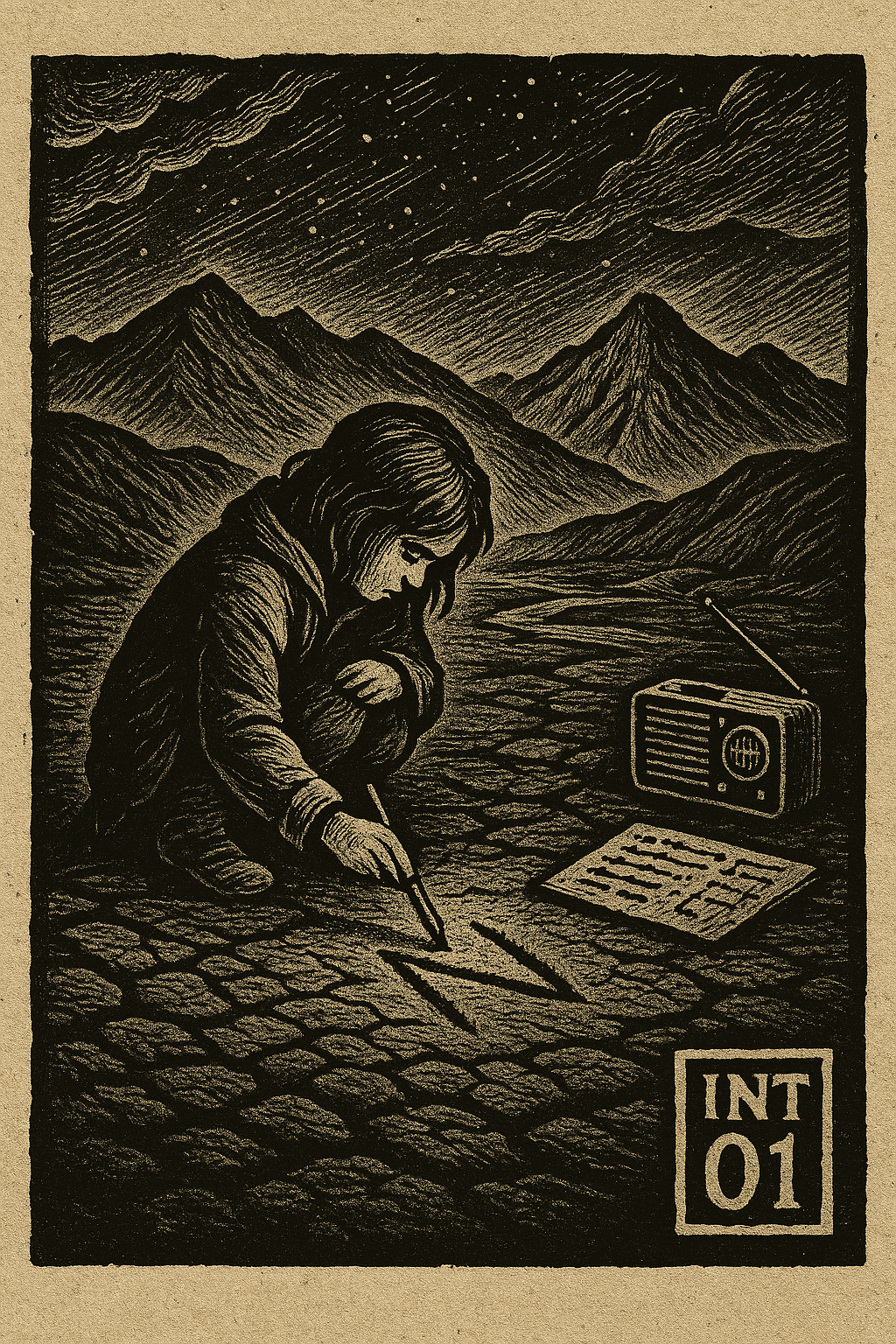
  • Interlude 01: Naomi’s Ledger

    # Interlude — Chapter 01: Naomi’s Ledger

    Naomi writes with a twig where the ash is soft as flour. She presses each letter hard enough to feel the grit under her nails. When the wind lifts the name too quickly, she writes it again slower, the way Ezra taught rhythm—steady, not loud. Around her the mountains fold like sleeping animals; in the pocket of her jacket are the slate chips Ezra scratched with dots and dashes.

    Tonight she tries the radio the way Ezra does, not calling for anyone in particular, just rocking the tuning through its slow breath. In the shallow of the static she hears a tick that is not sky. She answers with the smallest ‘A’ she knows. A reply comes back: **N**. She grins in the dark and finishes the word in the ash, then wipes it with her palm so the Beast can’t read the page in the morning.

    *Linked chapter:

    * [Read Chapter 01](/american-prophet/book-one/chapter-01/)

    *Next main post:* [Chapter 02](/american-prophet/book-one/chapter-02/)