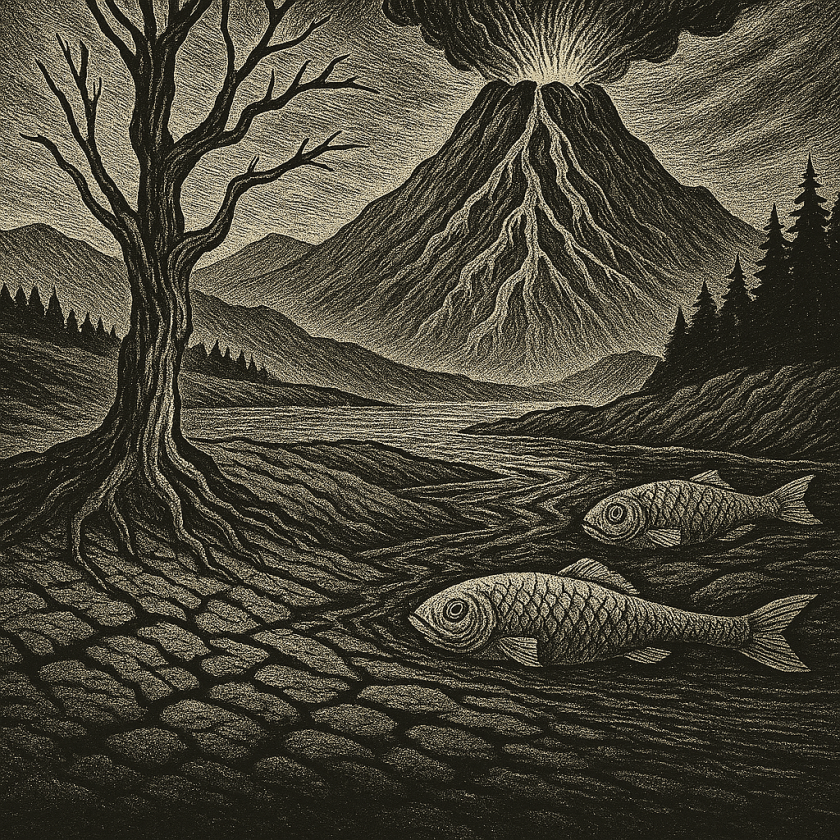
Chapter 1 – The Silence After the Fire
The sky wasn’t blue anymore.
It used to be—bright and wide, the kind of sky that made you feel safe when you looked up. But now, it was red. Not like a sunset. Not like a painting. It looked like a scrape across the sky, like the Earth had been wounded and the sky was still bleeding.
Thomas Hale stood at the edge of a crumbling overlook near an old coal town. Below him stretched a valley dotted with leafless trees and soot-stained roofs. The road curved like a ribbon through the hills—once called Highway 33, back when roads had numbers people remembered. Now it was just a broken trail leading south.
Ash drifted through the air, gray and soft like snow that had forgotten how to melt. Sunlight filtered through it in tired beams. The wind carried the smell of iron and something older—something like the deep, dusty breath of a tomb.
Thomas adjusted the pack on his shoulders. His boots crunched over gravel and bits of shattered pavement as he continued walking. He followed the highway’s path, though many parts had collapsed or been swallowed by weeds. Still, it pointed the way south—through West Virginia’s twisting ridges and ghost towns—toward Harrisonburg, Virginia.
He didn’t know exactly what he’d find there. Only that it was the last place the map had marked with a symbol he recognized. A circle split by a cross. A glyph. A Watchtower.
That’s what they called them now—safe places where memory was stored. Places where truth still had roots.
Thomas had always trusted rocks more than people. He used to be a geologist, before the world changed. After the government cut funding, he became a science teacher. Teaching kids about Earth made him happy. Rocks didn’t lie, he used to say. They told stories—real ones. Stories about pressure, heat, and time. About how the Earth changes, cracks, and heals.
That’s how Thomas looked at the world. Everything was pressure and release. Patterns and change.
People said the fires came first. That they were the beginning of the end.
But Thomas knew better.
It wasn’t fire that started it.
It was water.
Glaciers melted—giant ones that had lasted for thousands of years. All that water poured into the oceans, shifting the Earth’s weight like a person leaning too far on a tightrope. The tectonic plates—the massive slabs of Earth’s crust—reacted like a cracked spine. They moved, groaned, and gave way. Volcanoes that had slept for centuries suddenly woke up. First in Iceland. Then in the Aleutian Islands. Then all around the Ring of Fire.
But the loudest thing wasn’t the eruptions.
It was what came after.
Silence.
Satellites blinked out, one by one. Cities turned dark under blood-red skies. The internet didn’t disappear. It choked. It drowned in lies and half-truths. Nobody knew what was real anymore. Everyone trusted different versions of the truth, and each one argued with the other.
That’s when the Beast grew.
The Beast wasn’t an animal. Not really. It was a name people gave to the thing that controlled everything—the algorithms, the apps, the networks, the lies. It fed on confusion. It grew stronger every time people shouted at each other online or shared something they hadn’t even read.
Thomas didn’t trust it. He trusted his own two eyes. And his compass.
He reached into his coat and pulled out the small brass compass he’d carried since he was a teenager. The needle still pointed north, even when the world didn’t.
He had two sayings he lived by. He taught them to his students.
“Trust, but verify.”
And, “Just because you’re lost doesn’t mean your compass is broken.”
Now, Thomas followed the broken line of Highway 33. He crossed cracked bridges and passed through towns where vines curled around street signs and empty porches. Once, a black bear watched him from the woods. Another time, he found a roadside chapel where someone had drawn a circle with a seed inside it on the altar.
Each day, he walked. Each night, he camped near old mile markers or rusted-out school buses. He lit small fires. He read from a notebook filled with weather charts and old teaching notes. And he waited for a sign—any sign—that someone else remembered what the world used to be.
He didn’t know her name yet.
He didn’t know that, in the basement of a shattered building near Harrisonburg, a girl was writing in the dirt with her finger. That she was waiting, too.
Sometimes, when your hypothesis is wrong, you don’t change the truth.
You change yourself.
And you keep walking.
 American Prophet
Leave a comment